Solutions to Chapter 31 Truth in FOL

A. Consider the following interpretation:

  • ‣
    ​

    The domain comprises only Corwin and Benedict

  • ‣
    ​

    ‘A⁡(x)’ is to be true of both Corwin and Benedict

  • ‣
    ​

    ‘B⁡(x)’ is to be true of Benedict only

  • ‣
    ​

    ‘N⁡(x)’ is to be true of no one

  • ‣
    ​

    ‘c’ is to refer to Corwin

Determine whether each of the following sentences is true or false in that interpretation:

  1. 1.
    ​

    B⁡(c) False

  2. 2.
    ​

    A⁡(c)↔¬N⁡(c) True

  3. 3.
    ​

    N⁡(c)→(A⁡(c)∨B⁡(c)) True

  4. 4.
    ​

    ∀x⁢A⁡(x) True

  5. 5.
    ​

    ∀x⁢¬B⁡(x) False

  6. 6.
    ​

    ∃x⁢(A⁡(x)∧B⁡(x)) True

  7. 7.
    ​

    ∃x⁢(A⁡(x)→N⁡(x)) False

  8. 8.
    ​

    ∀x⁢(N⁡(x)∨¬N⁡(x)) True

  9. 9.
    ​

    ∃x⁢B⁡(x)→∀x⁢A⁡(x) True

B. Consider the following interpretation:

  • ‣
    ​

    The domain comprises only Lemmy, Courtney and Eddy

  • ‣
    ​

    ‘G⁡(x)’ is to be true of Lemmy, Courtney and Eddy.

  • ‣
    ​

    ‘H⁡(x)’ is to be true of and only of Courtney

  • ‣
    ​

    ‘M⁡(x)’ is to be true of and only of Lemmy and Eddy

  • ‣
    ​

    ‘c’ is to refer to Courtney

  • ‣
    ​

    ‘e’ is to refer to Eddy

Determine whether each of the following sentences is true or false in that interpretation:

  1. 1.
    ​

    H⁡(c) True

  2. 2.
    ​

    H⁡(e) False

  3. 3.
    ​

    M⁡(c)∨M⁡(e) True

  4. 4.
    ​

    G⁡(c)∨¬G⁡(c) True

  5. 5.
    ​

    M⁡(c)→G⁡(c) True

  6. 6.
    ​

    ∃x⁢H⁡(x) True

  7. 7.
    ​

    ∀x⁢H⁡(x) False

  8. 8.
    ​

    ∃x⁢¬M⁡(x) True

  9. 9.
    ​

    ∃x⁢(H⁡(x)∧G⁡(x)) True

  10. 10.
    ​

    ∃x⁢(M⁡(x)∧G⁡(x)) True

  11. 11.
    ​

    ∀x⁢(H⁡(x)∨M⁡(x)) True

  12. 12.
    ​

    ∃x⁢H⁡(x)∧∃x⁢M⁡(x) True

  13. 13.
    ​

    ∀x(H(x)↔¬M(x)) True

  14. 14.
    ​

    ∃x⁢G⁡(x)∧∃x⁢¬G⁡(x) False

  15. 15.
    ​

    ∀x⁢∃y⁢(G⁡(x)∧H⁡(y)) True

C. Following the diagram conventions introduced at the end of §23, consider the following interpretation:
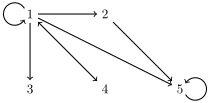
The numbers 1, 2, 3, 4, and 5 are connected by arrows.
There are arrows from 1 to 2, 3, 4, 5, and to itself, from 2 to 5,
from 5 to itself, and from 4 to 1. There is no arrow leaving 3.

Determine whether each of the following sentences is true or false in that interpretation:

  1. 1.
    ​

    ∃x⁢R⁡(x,x) True

  2. 2.
    ​

    ∀x⁢R⁡(x,x) False

  3. 3.
    ​

    ∃x⁢∀y⁢R⁡(x,y) True

  4. 4.
    ​

    ∃x⁢∀y⁢R⁡(y,x) False

  5. 5.
    ​

    ∀x⁢∀y⁢∀z⁢((R⁡(x,y)∧R⁡(y,z))→R⁡(x,z)) False

  6. 6.
    ​

    ∀x⁢∀y⁢∀z⁢((R⁡(x,y)∧R⁡(x,z))→R⁡(y,z)) False

  7. 7.
    ​

    ∃x⁢∀y⁢¬R⁡(x,y) True

  8. 8.
    ​

    ∀x⁢(∃y⁢R⁡(x,y)→∃y⁢R⁡(y,x)) True

  9. 9.
    ​

    ∃x⁢∃y⁢(¬x=y∧R⁡(x,y)∧R⁡(y,x)) True

  10. 10.
    ​

    ∃x∀y(R(x,y)↔x=y) True

  11. 11.
    ​

    ∃x∀y(R(y,x)↔x=y) False

  12. 12.
    ​

    ∃x∃y(¬x=y∧R(x,y)∧∀z(R(z,x)↔y=z)) True